
The Forgotten Virtue

In Michigan you get ten cents for returning empties, and my parents used to pull over and pick them up off the side of the road. My mother still drives six miles out of her way for the cheap gas in the rougher part of town, and most nights she eats whatever’s about to go bad in the refrigerator. She’s had the same dishwasher for forty years; the door slants down now, so the dishes slide out every time you open it. When I visit and offer to take her out, she’ll tell me she’s got some hot dogs in the freezer.
My mother was a visiting nurse, and my father, who died twelve years ago, taught high school history. She is eighty-three years old and has two and a half million dollars in the bank. None of this is about the money. For my mother, thrift isn’t a means to an end or an identity. She isn’t running the numbers or turning thrift into a self-improvement project. She has no real philosophy, and couldn’t articulate one if she did. It’s closer to a reflex—the visceral reaction of someone who can’t stand to watch a plate of food go in the trash.
As a kid, I thought my parents were idiots. Why would two working adults spend twenty minutes scrounging around in a ditch or risk getting carjacked at a gas station in Detroit? And it wasn’t that they were all that cheap. They may have spent a lot of time arguing about which gas station didn’t charge for air, but they’d drop seven thousand dollars on a family trip to Europe every summer.
But what I didn’t understand until I was much older was that I’d had it backwards. It wasn’t a calculation—it was a discipline. And it leaked into every aspect of their lives: what they threw away, what they let stay broken, how they treated the people around them. What I’d mistaken for stinginess was a practice. There’s a word for it, though we mostly use it now to mean cheap. The word is frugality—and we’ve forgotten it was ever a virtue at all. I caught the tail end of it, just before our culture stopped treating wastefulness as a vice and before anyone thought there was such a thing as wanting too much.
My grandparents would have recognized it instantly. My children have no idea it exists. My father was born in Detroit during the Depression. My mother’s parents were Mennonites who grew up in Ukraine during the famine of 1921 that killed as many as a million people. My Oma told us stories of eating grass and the straw from the roofs of their houses, during a civil war. They survived in part because fellow Mennonites in America and Canada sent food. A few years later they emigrated to Canada.
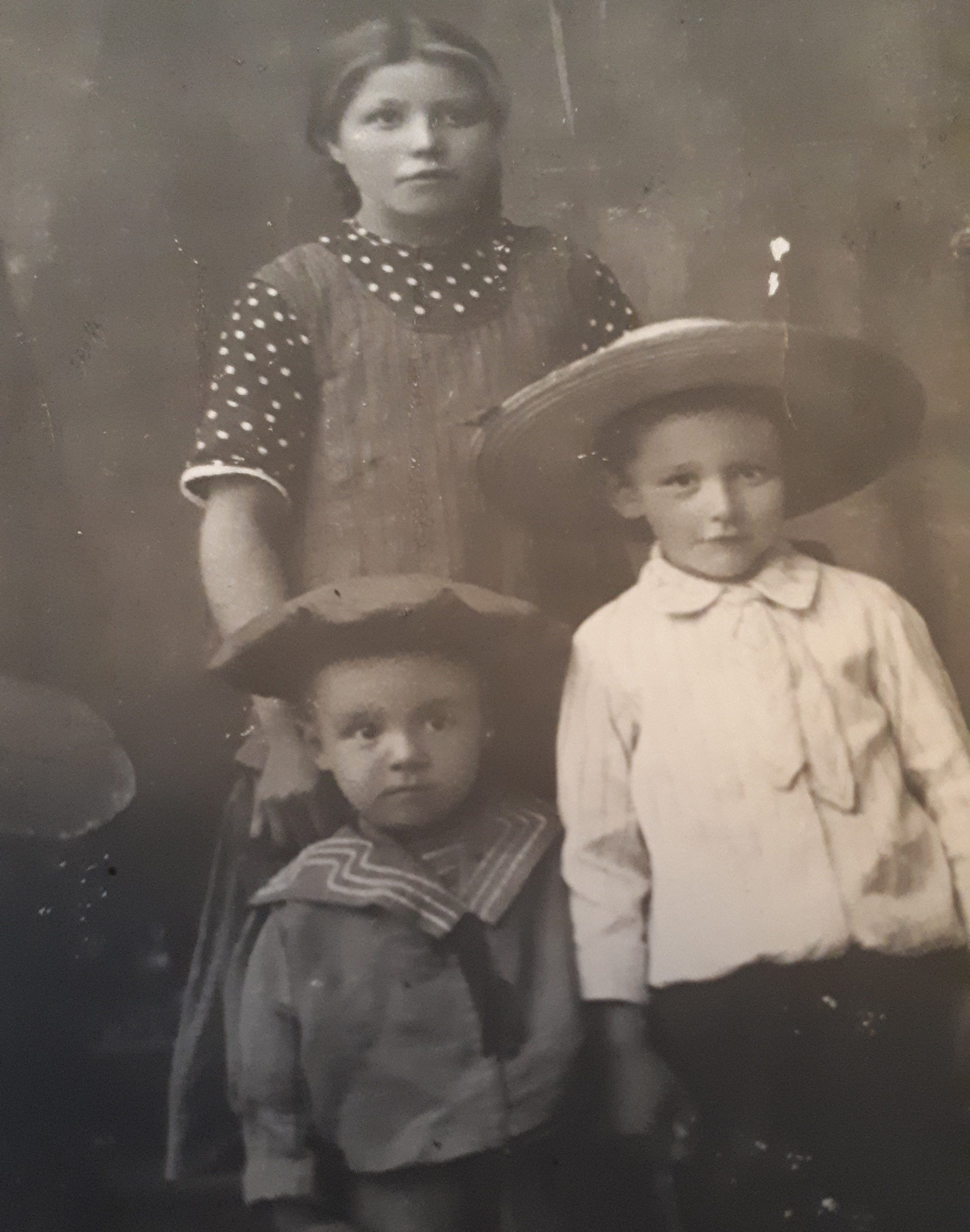
When my mom was little, her opa would ask her if she was the biggest one in her class. Not the smartest or the prettiest. The biggest. My parents were raised by people who had starved—for whom waste was unthinkable, and saving was never only about yourself, because giving meant survival. Waste was a sin.
Today the word “sin” survives mostly in advertising—”sinfully delicious,” “wickedly good,” “guilt-free,” the last one a faint vestige of a lost world where there was still something to feel guilty about. Although the word carried poison—the hellfire, the terrified children, the way it was used to damn people for who they loved—throwing it out cost us the whole moral vocabulary that came with it: sin, virtue, vice, grace.
Trying to talk about how to live the only life you get—what’s worth wanting, how to spend it—without these words is like describing a painting when half the colors have no names. You can point and say “blueish” or “kind of dark,” but you can’t say navy, or the color of a rusted-out fender. Without them you can still feel that something’s not right—that you have everything and somehow it isn’t enough—but you can’t put your finger on it, or even tell whether it’s a real problem or just a passing mood.
Sin was abused. It was used to declare war on pleasure, to make ordinary desires feel dirty, to let scolds feel righteous. And a lot of what got called sin was just being alive: a good meal, a day off when you weren’t really sick, dancing, sex, a joke that went too far. Every age has its own list of forbidden pleasures and taboos. The church had one. We have ours—we’ve just stopped calling it sin and dropped the God part. Not every indulgence is a vice, and not every denied pleasure a virtue—the miser starving himself to die rich is no closer to a life well lived than the glutton. But the poison and the purpose were tangled together and in throwing out the one, we lost the other.
The function sin served was older and deeper than anyone who used it understood. We decided the story was bullshit and assumed that meant it wasn’t doing anything. But practices that survive for centuries often carry an implicit wisdom. They solve problems the people performing them can’t see and couldn’t have invented on their own. This is what Edmund Burke saw in inherited custom — and what anthropologists mean when they call a cultural practice an adaptation: an order no one designed and no one fully understands, carried forward simply because the people who kept it out-competed those who didn’t. Nobel Prize–winning economist Friedrich Hayek made the same case about markets: the knowledge a price encodes is dispersed across millions of people and can’t be figured out by any single individual. A practice can rest on a myth and still tell us something true. The talking snake was nonsense; what it revealed about us was not. It’s what Chesterton meant by the fence in the field: don’t tear it down before you know why it was built. To reject something simply because you don’t like the story attached to it, without asking what it was doing, isn’t boldness. It’s arrogance—a failure of humility that assumes that because you can’t see the reason, there isn’t one.
So what was sin actually doing? It reminded you that you were a divided creature—that part of you wanted things you shouldn’t want and would lie to you about it—and that becoming a decent person meant struggling against that part instead of just giving in to it. Lose the words and you lose the struggle. The divided self is still there but you stop seeing it. Without the fight, there’s no character to develop—nothing left to shape you but your own appetites. It’s all id and no superego—a self to satisfy instead of one to get over.
All of this reflects a much bigger shift. The old moral language assumed the self was a problem to be worked on; the modern one treats it as an oracle: live your truth, trust your gut, you’re perfect exactly as you are. And once the self is sovereign, there’s no place left to stand from which wasting something, or wanting too much, could register as a failing at all. It’s just a choice.
My mother doesn’t understand any of this. If you tried to explain the divided self, or the implicit wisdom of an ancient cultural practice, she’d get irritated, say “oh, Robert,” and go back to wrapping the heel of the bread and putting it in the freezer. Last Thanksgiving I watched my sister scrape half a roast chicken into the trash. My mother called it a sin. She wasn’t moralizing. There was no thought behind it at all—the words just came out of her, the way “ouch” comes out before you’ve decided if anything hurts.
This is exactly how a good adaptation works. You don’t need to understand why waste is wrong any more than you need to understand why you flinch at a snake. Understanding was never the point. My mother is carrying instructions written by people who ate grass to stay alive, and she has no idea they’re there. She just knows you don’t throw food in the garbage.
We forgot that frugality was once a virtue the same way we forgot what sin was for. Both were ways of telling ourselves that we are imperfect, divided creatures, and that appetite is to be mastered, not indulged. It’s something a self that sees no dirt on its own side of the street can’t bear to hear.
My AA sponsor used to start all his shares the same way: “I’m Gill, and I’m a grateful alcoholic—because today I have a choice about whether to drink. Before, I didn’t choose. I just drank.” Gill was expressing a truth that humanity’s wisdom traditions have discovered across the ages—from Buddhists in India to Stoics in Greece to Christian monks in the Egyptian desert: the paradox of freedom. The freedom to satisfy every desire is its own kind of bondage, because a self that can’t say no to anything isn’t free; it’s just at the mercy of whatever it happens to want next. Viktor Frankl rediscovered this truth in Auschwitz, where, stripped of every other freedom, he found that freedom lies in the gap between stimulus and response. It is in the space between wanting something and reaching for it that we recover the power to choose.
Modern society has turned this logic on its head by thinking we’re most free when nothing stands in the way of our impulses. But a self with no gap between impulse and act isn’t free; it just does the next thing its animal appetite demands. This is the oldest trap in the business. Satisfying a desire doesn’t get rid of it; it feeds it. Desire begets desire. All the donuts in the world will never be enough.
Philosophers from Aristotle to the Stoics and Aquinas organized a life around virtue and asked what a good life was; we have organized ours around freedom and ask only what we want. They feared that a people without limits would become tyrants or hedonists. But the truth was smaller and more pathetic. We became consumers—reaching for the next thing, driven by appetites we mistake for choices.
So we keep reaching. But we’re no longer chasing pleasure; we’re trying to fill something. Waste isn’t bad because it’s inefficient. It’s bad because of what it reveals: the residue of a self trying to fill a hole, in a culture that has engineered the friction out of wanting. A click on Amazon, a tap on DoorDash, one more scroll—each shrinking the gap where you might have sat with the hole long enough to ask why it was there to begin with. But the hole was never an appetite. It was the place where meaning, a sense of purpose, and what your life was for were supposed to go. We’ve been trying to fill it with stuff because we lost not just the words for what belongs there but the whole moral order they described. You can see it in what we consume and what we throw away. My grandparents ate grass and the straw off their roofs to stay alive. Two generations later, the average American throws out more than three hundred pounds of food a year.
When the self becomes the highest authority, when nothing stands between wanting and getting, and everything is permitted, the shared moral order dissolves. We lose any agreed-upon sense of better and worse, and can’t even talk about how to live a good life without feeling embarrassed. This is nihilism—the collapse of any belief that something might be true, or that one way of living might be better than any other. The culture’s answer has been to wave the problem away: follow your passion, do what you love, and let the hard parts take care of themselves. But that misunderstands what life is. Meaning isn’t waiting with a margarita in the hot tub once all the dissatisfaction and pain are gone. It’s inside them. The struggle isn’t the obstacle to a good life. It is the good life.
You can put that struggle off, or paper it over by buying something every time you feel restless, irritable, and discontent so that you never quite have to feel it. But you can’t escape it, and if you keep putting it off, you never grow. (Imagine how good a person I would be if self-knowledge were enough.) You will always be ruled by your appetite, wanting what you want the instant you want it, unable to bear even the smallest gap between wanting and having. And you will never be free. Effort is what separates living a life from consuming one. It’s the price of meaning—and when you remove it from everything that matters, you don’t get a better life. You get one that isn’t worth living.
This is why so much of what we buy ends up in the trash. We were never really after the stuff. We mistook getting more for meaning, but were really after distraction—any way to put off the struggle. The thing itself, once it was ours, was just one more thing to throw away.
Nihilism produces narcissism, because it removes every standard you could be measured against. If nobody is better and nobody is worse, then we’re perfect exactly as we are. Frugality is the practice of admitting that we’re not. It tells us that sometimes what we want isn’t good for us, and that some cravings are better left unfed. It’s the rejection of the consumer’s answer to this sense of emptiness—an itch that only gets worse the more you scratch it.
But spending less is still not a virtue. The miser hoards out of greed, the man saving to retire at forty does so out of ambition, and the minimalist shows off his bare apartment out of vanity. All three spend little and waste less, but they’re as ruled by the self as any Amazon shopper—still wanting.
Real frugality—what the word used to mean, before we turned it into a synonym for cheapness—is what all three of them are missing. It’s thrift without ego. Not being stingy to add to your pile, not saving so you can quit your shitty job, not driving a 12-year-old Honda so people will admire your values. Frugality is a practice. You don’t throw half a chicken in the garbage, because waste is a sin. Because what you’ve been given is a blessing that was never only yours to throw away. It is the virtue we forgot. It’s what turns the small daily acts—the cans, the cheap gas, the heel of the bread—into a way of living.
The food you scrape into the trash was grown by someone, on land that could have fed someone, and it ends up in a landfill someone else has to live beside. Nothing you waste disappears—it just becomes someone else’s problem. This is what we forgot: frugality was never about you. It’s about everyone else—the recognition that you are not alone in the world, that you are one of eight billion, living, as my father used to say, in your own small corner of the universe.
On Ben Franklin’s list of 13 virtues, frugality was number 5: “waste nothing, but to do good to others or yourself.” Number 13 was humility, which many, including Franklin, saw as the governing virtue because it’s the one that keeps the others honest. Without it order can become tyranny, temperance joyless asceticism, and conviction zealotry. Hitler was courageous, and the Jacobins thought themselves just. Humility reminds us that we are not the measure of all things.
But you can’t practice humility directly. There’s no drill called “being humble.” That’s the problem with most of the virtues: they’re hard to get your arms around. How do you practice courage while filing your tax returns? Wisdom while doing the dishes? Generosity while mowing the lawn? The occasions come rarely, and never when you’re ready for them. It’s hard to schedule an hour of moderation.
Frugality is different. Its occasions are everywhere, woven into the most ordinary parts of the day. Every time you stand at the gas station, or fill a grocery cart, or scrape a plate, the choice is right in front of you: waste or don’t, spend or don’t. You don’t have to wait for the moment. It comes to you, a dozen times a day.
And practice, it turns out, is everything—because knowing a thing and doing it are almost entirely unrelated. I can tell you in great detail how to hit a backhand: get the racket back early, turn your shoulders, watch the ball all the way onto the strings. But in the middle of a point I rarely do any of it. What could be simpler than watching the ball? I’ve told myself to do this thousands of times. And still I find myself looking at my racket, where I want to hit it, my opponent, or something happening on the court next to me.
Our deep capacity for self-deception also often severs the relationship between knowing and doing. Fifteen years ago, I came up with what felt like an ingenious solution to my heroin addiction: I would lock the drugs in a timed safe and wean myself off. The first time I set the timer for six hours and spent the last ninety minutes staring at it, snorted my ration, and then reset it for ten hours. Three hours later I smashed the safe open with a hammer. No one understood my addiction better than I did. I understood everything except how to stop.
Self-knowledge didn’t get me sober. Going to meetings, making amends, and helping others did. Doing those things ten thousand times, until the doing took root somewhere in the unconscious parts of me that act on their own, without asking permission.
Frugality works the same way. It isn’t a philosophy you study and adopt; it’s a practice you repeat until it stops being something you do and becomes something you are. My mother never decided to be frugal. It wormed its way into her long before she could question it, put there by people who had no choice—and it’s still there, running underneath everything, quietly doing its good work whether she thinks about it or not.
But like the other virtues, frugality can be hijacked by the very self it was meant to discipline. Like meditation—a practice meant to dissolve the self, repackaged as a way to improve it—it can get enlisted to serve the ego. Frugality is meditation for the marketplace. What protects both of these practices is the one virtue the self can’t conscript. Every other virtue can be hijacked by pride—you can be proud of your courage, your discipline, your generosity, and they survive, just more stuff the ego admires about itself. Humility is the exception. The moment you’re proud of it, it’s gone. It is the one virtue that can’t be conscripted, because to claim it is to lose it.
Humility is what turns thrift into frugality. It’s the difference between hoarding for yourself and saving for everyone else. Thrift only becomes frugality when it stops being about you. Humility tells us we are not gods, but frugality allows us to practice it. It’s what self-forgetting looks like at the gas pump, on Amazon, and in the thousand small moments when desire disguises itself as need.
Frugality resists several sins at once—greed’s hunger for more, gluttony’s worship of appetite, pride’s need for display, sloth’s love of convenience—which is why a culture built on all four can no longer see it as a virtue at all. We can still see budgeting as prudence and minimalism as taste, but we’ve lost the moral core: frugality as a way of decentering the self, of admitting that you aren’t the only thing that matters, of leaving the last slice of pizza for someone else. We didn’t lose the virtue by escaping poverty or getting richer. We lost it by building a culture where the self is sovereign and getting what you want is the highest good—because a culture organized around endlessly feeding the self can’t recognize a virtue whose entire purpose is to feed it less.
The founders would have recognized the problem immediately. They saw restraint of the passions as the central human struggle, and understood that freedom was not getting whatever you wanted, but was the capacity to govern yourself. What separated human beings from the other animals was the ability to subordinate appetite to reason. It was an ancient idea that they had inherited. Milton had put it a century before them: “He who reigns within himself, and rules passions, desires, and fears, is more a King.” The man who cannot govern himself, he warned, is “subject himself to anarchy within”—ill-fit to govern anyone else. Madison made the same case for nations in Federalist No. 51: “If men were angels, no government would be necessary.” A government has to first be strong enough to control the governed, he wrote, and then “obliged to control itself”—the same restraint we ask of a person, asked of a country.
Today we have done the opposite: built a culture that calls the ungoverned man free and the disciplined one repressed, that treats appetite as authenticity and restraint as cowardice—and then acts surprised by the leaders it produces. But these leaders are only symptoms. The rot is the sovereign self we’ve spent decades celebrating: a self that answers to nothing but its own desires.
My aunt Betty was ten years old when she left Ukraine. She never married and never had children of her own, but she had nine nieces and nephews. She spent most of her life bottling ketchup at the Heinz plant in Leamington, Ontario. She lived in a one-bedroom house and often ate cornflakes for dinner. A few days after Christmas every year — what we called Aunt Betty’s Christmas —she had everyone over, cramming all the families into that little house. Every family went home with the same two gifts: a big bottle of Heinz ketchup and a five-gallon jug of Tide. No wrapping. No plastic, nothing shiny, nothing you’d throw in the trash by February. When she died, she left more than a million dollars, divided among some twenty-five grand-nieces and grand-nephews.
I caught the tail end of it. I freeze the heel of the bread and get upset when food gets thrown in the trash. But I’m the watered-down version. My grandparents ate grass to stay alive; I was raised with coupons but a refrigerator that was always full; my kids think whatever you want shows up on the porch the next day.
In the end, you are what you do, not what you think or believe. Repeated across a lifetime, these small acts harden into what we used to call character. My mother knows none of this, and if she ever read this essay, she’d quit somewhere around the word “nihilism.” She didn’t send us to the movies with our own popcorn, give us powdered milk, or jam the nearly empty bag of chips into our lunchboxes rather than waste a Ziploc because she wanted to embarrass us, or because she’d thought about appetite or stewardship or the bondage of the self. She did it because waste is a sin. Because there are hot dogs in the freezer.
"They feared that a people without limits would become tyrants or hedonists. But the truth was smaller and more pathetic. We became consumers—reaching for the next thing, driven by appetites we mistake for choices."
This was exactly the sermon I needed. I purchased an item on Amazon last week, and when I opened the box, I knew I would never use it. It was a small item, only $12, but it had been an impulse purchase. As I unwrapped it, I thought I should just throw it directly into the trash, because I knew it would never be used. But I lied to myself. I put it in my closet, saying, "Maybe someday it will come in handy." But in reality, I know that instead I will just pay again and again to move that thing from one home to another, and one day when I die someone else will throw it out. So, feeling properly shamed by your article, I just went up to the closet, took it out, and threw that brand-new item in the trash. I wanted to *feel* the pain of the sin. I wanted to feel the burn of that brimstone on my ass to remind me, next time, that impulse purchases don't buy happiness. Thank you, Pastor Lynch, for reminding me of frugality and of sin.
Robert, once again you've knocked it out of the park with this essay. In case you ever think that your time spent in addiction and recovery, or your humbling comedown from working with Trivers (Trivers!) to substitute teaching have been a waste of your time and talent, let me set you straight. That was the necessary training ground for what you're doing now. All of that gave you the life experience, the humility, and the wisdom, to write what you're writing in these essays on Substack. I see the hard labor and the honesty you're putting into each of these. If you keep this up, I think you are certain to grow a big audience. I see it accelerating lately with some high-traffic pieces. It may take longer than you like, but work of this quality can't be ignored. Keep going.
Good column. The author Thomas McGuane refers to our modern consumer culture as “the fiesta of consumption we call the American Way”. A terrific turn of phrase.