

It was January in Finland and the group of new researchers stood shivering in the awkward silence, for which Finns are legendary, waiting for the photographer to arrive. It was our first day of work, and our new boss, a woman in her early fifties saved us, asking: “Does anyone know any good jokes?” I have performed stand up comedy in clubs across New York City and quickly scanned my memory for the best jokes I’d written or heard. I quickly realized, however, that there was no way in hell that I was going to break the ice with a joke about abortion or prison rape; especially not with co-workers in a Sociology Department. Luckily, Marika let us off the hook by answering her own question: “A child molester and a kid are walking into the woods together as it’s getting dark. Kid says, ‘Hey mister I’m scared’. Child molester answers ‘ You’re scared. I have to walk out of here alone”. Not bad for a Finnish sociology professor and I appreciated the guts Marika showed by telling it and putting everyone, well me at least, at ease.
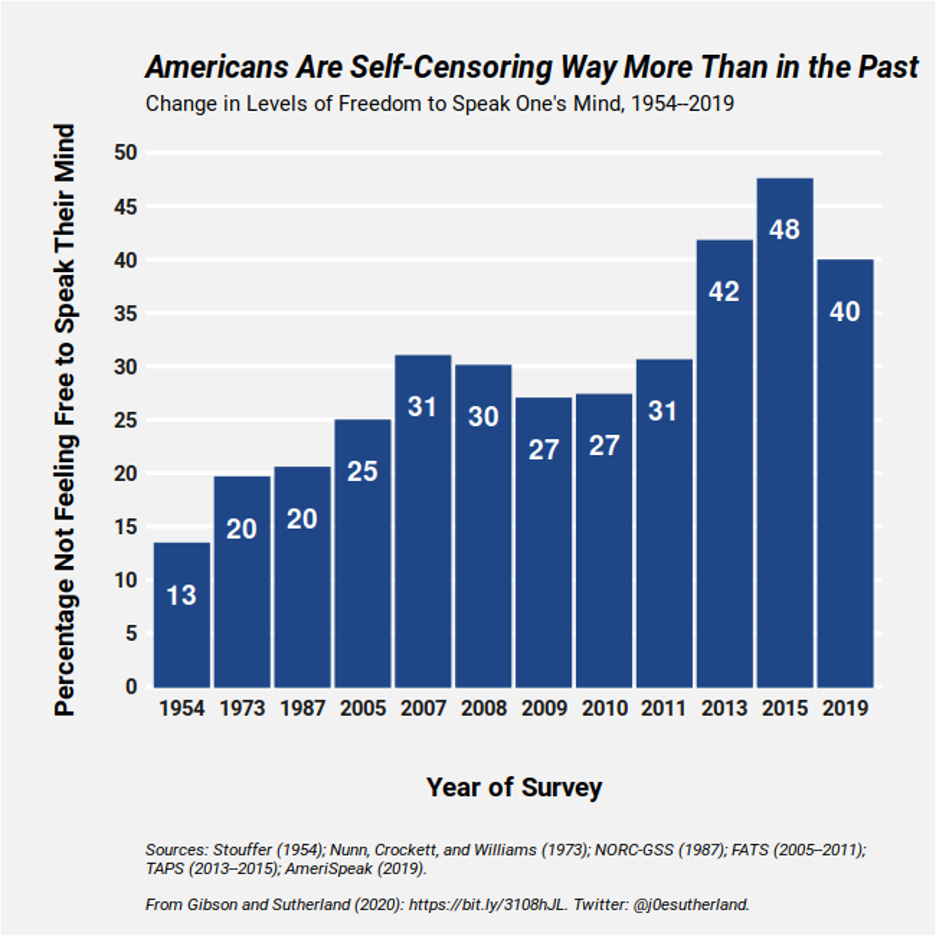
Over my 15 years working at universities in the United States I have never heard anyone tell a real joke — not a corny pun or some stupid meme — but one that actually made me laugh. You know, a funny one. Good jokes can be dangerous and the risk of getting in trouble is too high. Even though I suspect that many of my American colleagues might secretly have found Marika’s joke funny, there are too many land mines out there and laughing at the wrong joke is simply not worth the risk. There is a dark paranoia that hangs over America these days and attempts at humor can get you fired. A professor was fired earlier this year for a Facebook post suggesting that Iran’s supreme leader, Ali Khamenei, should tweet a list of beloved American cultural heritage that he would bomb, including the mall of America. Survey data show that nearly half of Americans no longer feel free to speak their minds, a number that has tripled since the question was first asked 60 years ago. One can only imagine what it is for jokes, which often depend on taking significant risks.
In Finland, however, I quickly realized that there was no danger, so at lunch the next day I told one of my jokes about how I plan to survive my first day in prison — “I would march straight up to the biggest, baddest, toughest motherfucker in the yard … and start sucking his dick”. Some of my colleagues laughed, most sat silently unamused, and others just looked confused. But I never heard from Human Resources, no complaints were filed and I wasn’t fired. My years in Finland often felt like a time warp — a flashback to what the United States used to be like. Things routinely happened there that I had not seen since I was a kid — like people telling jokes. If you grew up in the seventies, jokes were everywhere. In Detroit, where I grew up, most of them were Polack jokes, including the classic — “How many Polacks does it take to screw in a lightbulb? Three. One to hold the lightbulb and two to spin him around.” These jokes were so common that it wasn’t until Middle School that I realized that not every joke had to involve a guy from Poland. But before Marika started firing off dirty jokes every time she got the chance, I couldn’t remember the last time I’d heard one. In America, jokes have almost entirely disappeared from public contexts. They have become a discreet affair, reserved for trusted friends.
It might not be so bad if the prohibition against telling jokes and policing of humor was limited to stand-up comedians, television or even scripted jokes like those told by Marika, but the problem seems to have bled into our everyday social interactions. Last week, I was listening to my wife’s co-workers take turns sounding off about all the selfish assholes walking around town without masks. I helpfully added that, although I appreciated that everyone else was wearing a mask, I didn’t like to, and had a doctor’s note excusing me by explaining that the straps hurt my ears. I don’t know if they understood that I meant this as a joke, or if they just thought it was in poor taste because I didn’t insert a ‘tears of joy’ emoji after my comment. I do know, however, that they all hate me now, and that one has even let my wife know that she is ‘there for her’ if things were bad at home. Sometimes, however, it is clear that the intention is missed entirely. I was at my two year old son’s Montessori school interview last week and I asked his new teacher, “What’s your sexual harassment policy?” In a response straight out of a human resources training manual she answered “If we see any inappropriate behavior we notify the parents and take corrective action.” Not finding my stupid joke funny is one thing, but not understanding that it was supposed to be a joke is another. Detecting humor is a talent and refining this skill depends on hearing it.
The dispute about the propriety of certain jokes is regularly rehashed every time a controversial comedian releases a special or someone tweets something deemed inappropriate. One side says that humor insidiously molds our attitudes and that we must vigilantly censor jokes that might offend in order to reduce prejudice and protect the powerless. The other bristles at any attempt to restrict free speech and contends that a generation of woke millennials empowered by too many participation trophies has become too fragile to hear ideas that might upset them. For every self-righteous progressive seeking to out sexists for what are often innocuous statements, there is another outraged conservative saying things that are blatantly sexist to honor and defend her first amendment right to offend. Because all of these arguments make basic assumptions about which jokes are funny and how humor shapes our beliefs, resolving them hinges on an understanding of the basic purpose of humor. This essay is about why we laugh and tell jokes and what happens when we lose this ability. Instead of asking what is funny— a question that is deeply personal and ultimately impossible to answer — we should be asking why is funny.
The Superiority Theory was the earliest attempt to explain humor. This view, commonly attributed to Plato, argues that laughter is triggered when we express feelings of superiority over others. Although this hypothesis is rarely cited, it is the tacit justification for why offensive comedy should be forsaken and is characterized by opinion pieces explaining that punching down is never funny, why ridiculing the non-privileged is just mean or how offensive humor is psychological abuse. An article in Harpers explains that “Punching at the less powerful is just cruelty.” Although the Superiority Theory can fit our intuitions about why people laugh, this is an illusion, and despite decades of research, it has received almost no empirical support. The problem is that the hypothesis is based on a fundamental misunderstanding of humor’s function. Jokes frequently have nothing to do with feeling better than others and there are many situations where feeling superior doesn’t lead to laughter. We can, for instance, feel better than dogs, squirrels or insects without howling at their stupidity and the sight of someone who is homeless is more likely to induce pity than side-splitting laughter. This is to say nothing of the countless variety of other situations that produce laughter but are unlikely to elicit feelings of superiority, such as witty comments, puns or even being tickled.
Superiority theory is also inconsistent with what we know about the role of humor in disrupting, rather than perpetuating, hierarchies. Larry Wilde in his book Great Comedians Talk about Comedy says that one of the characteristics that almost all of the comedians he interviewed shared was a nearly universal discomfort with status and hierarchy. Seinfeld expresses this view in a bit on why comics should never receive awards:
“Your whole career as a comedian is about making fun of pretentious, high minded, self-congratulatory B.S. events like this one. The whole feeling in this room of reverence and honoring is the exact opposite of everything I have wanted my life to be about.”
The power of humor, therefore, isn’t in preserving the status quo and current power structures, but rather lies in its ability to uncover truths that are often overlooked by those in power. My own research published in the journal Evolution and Human Behavior shows that humor can reveal unconscious beliefs which can provide us with insight into our own biases and those of others. In this way, comedy provides a way to poke holes in orthodoxy and reveals our blindspots. In this interpretation, comedians and jokes pose more of a threat to the ‘pretentious, high minded, self-congratulatory B.S.’ handed down by cultural elites informing us that “punching down” is never funny, than it does to groups presumed to be powerless. It is also hard to know how much the guidelines prescribing what we are allowed to laugh at are being enforced by the finger wagging class and how many are actually buying it. Dave Chapelle’s scathingly anti-woke special ‘Sticks and Stones’, for example, received the maximum approval rating of 99% from viewers, 35% from critics and a stunning 0% from ‘Top Critics’ on Rotten Tomatoes. This divide between the views of elites and everyone else about what is funny can also breed resentment. Some have even attributed Trump’s election to many Americans coming to believe that they weren’t allowed to make jokes about anything anymore.
Some comics, like Chapelle, have dismissed criticisms about punching down on other grounds, arguing that some jokes, like those making fun of transsexuals, can help to normalize them. My blind brother-in-law, for example, is irritated that comedians never make fun of blind people. Most people don’t really want to be that special or at least not so special that nobody is allowed to make fun of them. Teasing can serve a similar function and being the kid who rather than getting teased is just ignored can be its own kind of hell. Key and Peele satirize this view in a sketch about a comedian working the crowd.The comic scans the room, in turn making fun of a fat guy, a European and a girl with big tits, when he comes upon a badly disfigured gay man in a wheelchair who speaks through a hole in his throat. An awkward silence follows as the man begs to be made fun of while the comedian desperately searches for an alternative target. The English philosopher Roger Scruton argued that ethnic jokes helped to normalize new immigrants to America by allowing Poles, Irish, Jews and Italians to laugh off their differences. Being someone that nobody is allowed to tease also makes you especially vulnerable to the one asshole who never got the memo. Nassim Taleb argues that some systems, including the human psyche, are ‘antifragile’ and need shocks, stress, and uncertainty to properly develop. In this interpretation, teasing can build character and inner strength. None of this is to say that there isn’t a shameful history of some humor, such as blackface, being used to humiliate people, nor is it to argue that insults can’t be disguised as jokes. The tell, however, is whether it was meant to be funny and people are often better at determining another person’s intent than you might think, so a more charitable interpretation might even be able to distinguish between bad jokes and put-downs.
Confusion about a joke’s target is another reason that the Superiority theory view that humor is an expression of power over others has been so difficult to upend. Not all jokes that involve black people are making fun of them — after Obama’s election in 2008 which coincided with the peak of the financial crisis, the Onion ran the headline: ‘Black Man Given Nation’s Worst Job’. Mistaking the subject of a joke for its target can also be magnified when you are the butt of your own joke. This type of self-deprecation can make it difficult to recognize the real mark which also makes judgements about whether a joke is punching up, down or sideways even harder. One time, at the end of our weekly anthropology department staff meeting, a colleague brought up the allegations against Anthony Weiner. Before I had the time to reconsider my stupidity, I blurted out “I mean, come on!!.. Who hasn’t sent a dick pick?!” I don’t know what I was expecting, but the whole table went silent and I was actually afraid that I might get fired. To me it was obvious that I was making fun of myself as being the kind of sleazebag who was so clueless that he didn’t realize that not all professors were into sending or receiving pictures of penises on their phones. But for some reason nobody laughed at my hilarious joke and I suspect that this was because they were confused and thought I was joking that sending a picture of your penis to random women on the internet wasn’t such a big deal.
Confusion over humor’s target is also likely to increase when jokes address sensitive subjects or are not understood by everyone. Larry David compares comedy to diving saying that you get more points for degree of difficulty. Although writing a good Hitler joke might yield more laughs, it also increases the danger that someone will think you are endorsing the Holocaust. This is exacerbated by the fact that humor relies on ambiguity. The more you explain a joke the less funny it becomes. As E.B. White noted, “Explaining a joke is like dissecting a frog. You understand it better but the frog dies in the process.” Flamson and Barrett confirmed this intuition in a 2008 study in the Journal of Evolutionary Psychology by showing that making jokes more explicit made them less funny. One of the reasons this happens is because a joke often works like an encrypted code between sender and receiver where shared knowledge is required to understand or get it. This is the essence of the inside joke. If everyone got it, it would no no longer be funny. But this is not just true of jokes, it’s true of nearly all communication of shared experiences. I have a joke where I play with the idea of insider knowledge by talking about my colleague in the Anthropology department who I assume everyone already knows from his famous work on alternative mating strategies in the red-tufted lemur. I then go on to presume that the audience has all this inside baseball knowledge about various esoteric theories in biological anthropology and end with a punchline exposing my colleague for the fraud that he is for intimating that Homo Ergaster might be a descendant of Homo Heidelbergensis! Ha, what a clown! The inherent and often necessary exclusivity of jokes can rub those who think that everybody needs to be in on every joke, lest they harm those who might feel left out, the wrong way. It’s also the reason why jokes that are so inclusive that they try to appeal to everyone, like America’s Funniest Home Videos, are both so popular and so predictably stupid (e.g. kid fell off his bicycle again, but don’t worry nobody got hurt).
But the real reason that we often don’t think that jokes are funny is not because we don’t understand them, but because they aren’t. Being funny, especially in front of strangers, is really hard. If you don’t think so, just go to any open mic and watch amateur comics awkwardly struggle through their sets, or better yet, just watch my first ever cringe-worthy performance at the Gotham Comedy Club in Manhattan here. Testing new material and failing — i.e. telling jokes that aren’t funny — is an integral part of the process of producing humor. Even a seasoned veteran like Seinfeld can spend 15 minutes on a single syllable to get a joke right and never knows if a joke will work until he tells it in front of a live audience. Good jokes evolve over months and years and the same material can bomb one night but then, after a few subtle tweaks, kill the next. They are always a work in progress and require critical feedback from an audience and this is not just true of stand-up. All humor works this way and we only get better at it by practicing it with others. Jokes involve risk and when we aren’t allowed to fail we stop telling them.
The best supported scientific explanation for why we laugh is called Incongruity Theory and the Superiority theory is now considered by most humor researchers to be wildly implausible. Incongruity Theory proposes that humor occurs when a contradiction violates our expectations. Then, when it is identified, it alters our perspective and leads to laughter. In the language of stand-up comedy, the set-up creates the expectation and the punchline violates it. The Onion often puts them both in a headline, such as ‘School Bully Not So Tough Since Being Molested’. This joke not only illustrates a key distinction between the Superiority and Incongruity theories, it also highlights the often subtle distinction between the subject and the target of a joke. While the Superiority theory presumes that the joke is making fun of people who are either bullied or molested, Incongruity theory suggests that the humor lies in the conflict, and surprising relationship, between being both a victim and a perpetrator at the same time. In the latter interpretation, the schoolyard bully is being restored to his rightful status by someone who holds the lowest rung in our society — the lowly child molester. George Meyer, writer for The Simpsons, encapsulated Incongruity Theory when he said that appreciating humor is “like seeing in two dimensions and then opening the other eye or looking through a View-Master and suddenly seeing in three”. Research showing that humor can help to undermine cognitive biases, identify faulty logic and detect mistaken reasoning lends support to this intuition.
My research with the evolutionary biologist Robert Trivers has shown that more self-deceptive people laugh less. This finding builds on Incongruity Theory and indicates that our ability to detect humor is inhibited when we lie to ourselves. Because humor often involves identifying contradictions and revealing new perspectives, this suggests that the less you are in touch with reality, the less likely you are able to identify that something is amiss. This is because rational thought often depends on the ability to view a situation from multiple angles, the better to get a less biased overview. If you are practicing self-deception and blocking out certain angles, however, you will fail to see the contradiction and therefore fail to enjoy the humor when these viewpoints are challenged. Leslie Savan, writing for the Nation, has argued that Donald Trump is likely to be highly self-deceptive based on the common observation that he is almost never seen laughing. But what’s good for the goose is also good for those on the other side of the political spectrum, and I would make the same point about some of my colleagues in the cultural anthropology department whose seeming inability to detect any sort of humor gave me the idea for the study in the first place.
A complete theory of humor, however, should take into account its evolutionary function. Evidence that other species also laugh, such as chimpanzees and mice, supports the logic behind taking a broader perspective and this requires an understanding of what adaptive problems humans faced in the distant past that appreciating humor solves. Using this framework, evolutionary biologists have converged on the view that laughter — the signal that we appreciate an attempt at humor — is, at its root, play behavior. Play frequently involves mimicking aggression through fighting, stalking, hunting or fleeing, all of which can be mistaken for aggression. Therefore stereotypical signals telegraphing that the behavior is not threatening have evolved and almost always precede mammalian play. Chimpanzees and human children, for example, laugh when they are being tickled or chased, and a study by the primatologist Takahisa Matsusaka showed that this laughter is a signal to the chaser that the interaction is not being perceived as threatening and that play can continue.
Understanding the role of humor in distinguishing between aggression and play is not only likely to shed light on it’s evolutionary function, it also offers profound insights into how they are connected. Because jokes are designed to feign aggression, and are therefore lame if they are too tame, it can be difficult and sometimes impossible, to disentangle them from real threats. These intricate relationships between humor, play behavior and threats will often make the coincident demands for jokes to be both funny while offending no one impossible to achieve. A study analyzing the connection between the funniness and offensiveness of religious jokes concluded that being offended was too unpredictable of a phenomenon to use as a basis for attempts to restrict aggressive humor. This leaves a choice — either increase our tolerance for humor we don’t like, or concede to the rising demands for increasingly neutered, politically sanctioned jokes and accept the consequences. We can’t do both because humor’s mission is not the same as Hallmark cards and jokes aren’t lessons from the gender studies department. The prime directive is to be funny, not to repeat platitudes or promote an ideology.
If we do decide that certain types of jokes are simply no longer worth the risk, we should understand the costs. In addition to helping people cope with anxiety, embarrassment, grief, and even physical pain, humor provides ways for people to react to threats, setbacks, social blunders, misunderstandings, and a countless variety of other mild disturbances. Because humor is logic chomping, it can also expose paradoxes and reveal hidden truths. My research shows that individuals laugh more in response to jokes that match their unconscious beliefs, which provides support for the folk wisdom that we find things funny because we think they are true. Laughter can also reduce tension and promote social bonds; across all cultures it is rated as one of the most important traits people look for in a mate. But perhaps the most important benefit humor can have for society today lies in its unparalleled ability to reduce tribalism. By undermining identity, easing tension and promoting humility, humor encourages us to take ourselves and our ideas a little bit less seriously and allows us to entertain the possibility that we might be wrong by forcing us to reckon with truths to which we are blind. Like a geiger counter detecting radioactivity, my inability to laugh can alert me to another insidious and often invisible toxin — self-righteous indignation. Cultural critic Neil Postman saw humor as an antidote to fanaticism in his 1995 book The End of Education,
“To be able to hold comfortably in one’s mind the validity and usefulness of two contradictory truths is the source of tolerance, openness, and, most important, a sense of humor, which is the greatest enemy of fanaticism.”
In this way cultivating a sense of humor can be a spiritual practice, reminding us of our common humanity. By several measures political polarization has reached levels not seen since the Civil War and jokes can offer some relief to the exhausting politicization of every conceivable issue. By realigning or disrupting group identities, humor can show people that human beings are defined by more than their political beliefs. Circumscribing the rules around humor in the midst of extraordinary divisiveness does not bode well for jokes being interpreted charitably or forgiving people for making mistakes. Just like comedians, we need to be given the latitude to test out new material. Humor is both complicated and demanding. It relies on ambiguity, insists on a nuanced understanding, can be exclusive, and requires forgiveness when it doesn’t land. Although these are difficult needs to satisfy, jokes offer much in return. Good jokes allow us to see things from a new perspective and by doing so often reveal our basic sameness by reminding us of one of the great spiritual principles — ‘There is no they!’
Whether we see jokes as threatening or playful will be determined by how we view their purpose. If humor is just another way to exert superiority, reinforce stereotypes and denigrate the most vulnerable, then humor will be seen as a threat. If, on the other hand, humor is fundamentally about seeing reality more clearly, challenging dogmatism and broadening our perspective, which is what most research suggests, then jokes will be seen as more benign and will also be funnier. Our perspective on this matters because we are the ones who decide what jokes mean, and when intent is obscure or impossible to determine, a more charitable interpretation is probably a good practice anyways. This doesn’t mean that jokes are never malicious. Nor does it mean that people will never gleefully mistake the subject of a joke for its target, or mistake a joke as an endorsement rather than a critique of some vile notion. A more fundamental problem, however, is when people confuse what people think with what they think is funny. In his Netflix special FREEDUMB, Jim Jeffries addresses those in the media who he knows will view his jokes about Bill Cosby as expressing support of a convicted rapist,
“This is not my opinion. Not something that I think. It is something that I think is funny. There is a big fucking difference between things that I think and things that I think are funny to say.” He follows with the punchline: “You know who never had someone protest their gigs because of his material… Bill Cosby!!”
This isn’t to say that a joke never reveals someone’s actual opinion, but assuming it always does is ridiculous.
Regardless of what you think is funny, circumscribing which material is appropriate is antithetical to the very notion of comedy. In order to be funny, jokes must offer up new ways of seeing things, and this often includes talking about things that push the limits of what is acceptable. When taboo topics are combined with our tendency to confuse a joke’s subject with its target, and our frequent inability to accurately distinguish between aggression and play, a perfect storm for humor to be misunderstood can ensue. This is because understanding a joke frequently requires the humility for us to admit that we could be wrong. But even if humor doesn’t always help us to question our beliefs, it almost certainly allows us to take them less seriously, and maybe this is enough.
But perhaps the simplest reason why we should be more tolerant of humor is because not all of it is for us, and we don’t have to like all of it in order to benefit from it. I would rather watch a Caillou marathon than watch the terminally stupid and pretentious, NPR-approved, comedic stylings of the milquetoast Mike Bribiglia. I also hate George Lopez and the irritating and infantile Adam Sandler. But guess what? I don’t have to watch them. I also know that these comics are loved by millions of people who are all happier and better off being able to laugh at their insipid horseshit. And this makes me and my country better off too. At their best, jokes provide a way to broach difficult topics and allow us to see beyond our differences. They allow us to discuss things that are hard to talk about and unite us in a myriad of subtle and intricate ways. An America left only with politically sanctioned jokes is unlikely to have the effect that many might imagine. Rather than making the world less cruel, it is far more likely to ratchet up the outrage, make it harder for people to get along and even more difficult to talk about the issues that divide us. And it will do all of this without offering a badly needed relief valve for an increasingly smug and intolerant population.
Since the 1970’s Americans have become increasingly polarized, trapped in exhausting culture wars and, by most metrics, less happy. In 1960, 4% of both Democrats and Republicans reported that they would be disappointed if their child married someone from the opposite political party. By 2018 these numbers had risen to 45% for Democrats and 35% for Republicans. During this same period, measures of overall happiness have plummeted. Meanwhile, a far less polarized Finland was ranked as the happiest country on earth for the past three years in a row. These differences are the result of a complex array of social, political and cultural pressures, and our decreasing aptitude for telling jokes and detecting humor is more likely a consequence than a cause. But humor can also be an antivenom. It can help a diverse society of people who often don’t like each other to relax more, take ourselves less seriously, and get along better. Being funny often depends on bringing up topics that we’re most afraid to talk about. If we lose our ability to laugh about the difficult issues, I fear we may lose the courage to bring them up at all. Humor allows us, if only for a moment, to break out of our imprisoning identities where politics has become a religion and any sign of nuance is a dog whistle. Jokes entail risk, because in order for them to work, they need to be a bit unsettling, and to get better at telling them we need to be allowed to fail. So people will get offended, and this will probably happen a lot. Still, the costs of letting others decide for us what we think is funny or appropriate are immense. Like all other play behavior, recognizing and evaluating jokes ourselves is crucial for navigating the social world, and making and getting a joke without a LOL emoji requires finesse. You have to learn how to do it — it’s part of growing up.