
Everyone Knows Soccer Is Boring
How the beautiful game convinced the world that boredom is sophistication

Every four years the world gathers to remind Americans that soccer is boring. The World Cup arrives, a billion people weep with joy, and everyone who wasn’t indoctrinated before the age of six sits there waiting for something… anything to happen. Then suddenly it almost does. Then just as quickly it doesn’t. Then it almost does again. This is the rhythm of the world’s most boring game.
It’s “the beautiful game,” and for most of my adult life I’ve been patiently informed, usually by someone who calls it fútbol, that I simply lack the sophistication to appreciate it. But they’re wrong. Soccer isn’t beautiful. It’s boring—and it has nothing to do with sophistication.
The Better Team Loses Almost Half the Time
One of the best ways to determine how much luck is involved in a sport is to measure how often the worse team beats the better one. If the favorite wins 80 percent of the time, that’s a high-skill sport: the better side reliably prevails, and the remaining 20 percent is luck. If the favorite wins 55 percent of the time, you’re watching something closer to a coin flip.
By this measure soccer is the most random major sport there is. The favorite fails to win 45 percent of the time—higher than baseball (44.1%), hockey (41.4%), basketball (36.5%), and football (36.4%). Compare that to tennis, where over five sets the favorite loses only about 21 percent of the time. In other words, play long enough and skill wins out. In an average ninety-minute soccer match, the better team is only slightly more likely to win than the better player is in a single hand of poker. Both are basically coin flips.
The main thing that drives the randomness is low event count. A basketball game, for example, has around a hundred possessions per team. A tennis match has hundreds of points. But a soccer match can turn on a single shot hitting the crossbar, one bad call, or a ball bouncing off someone’s shin. There’s simply not enough scoring for skill to drown out luck.
But take a look at the order of those upset numbers, because it’s not random. The more a sport leaves to chance, the more boring it is to watch—because the whole pleasure of sports is watching effort and skill get rewarded, and a coin flip rewards nothing. Soccer sits at the very top, but baseball is right behind it, which is exactly why baseball is also so boring—three hours of it, and then, oops, the ball clears the wall by a foot. The worse team wins again.
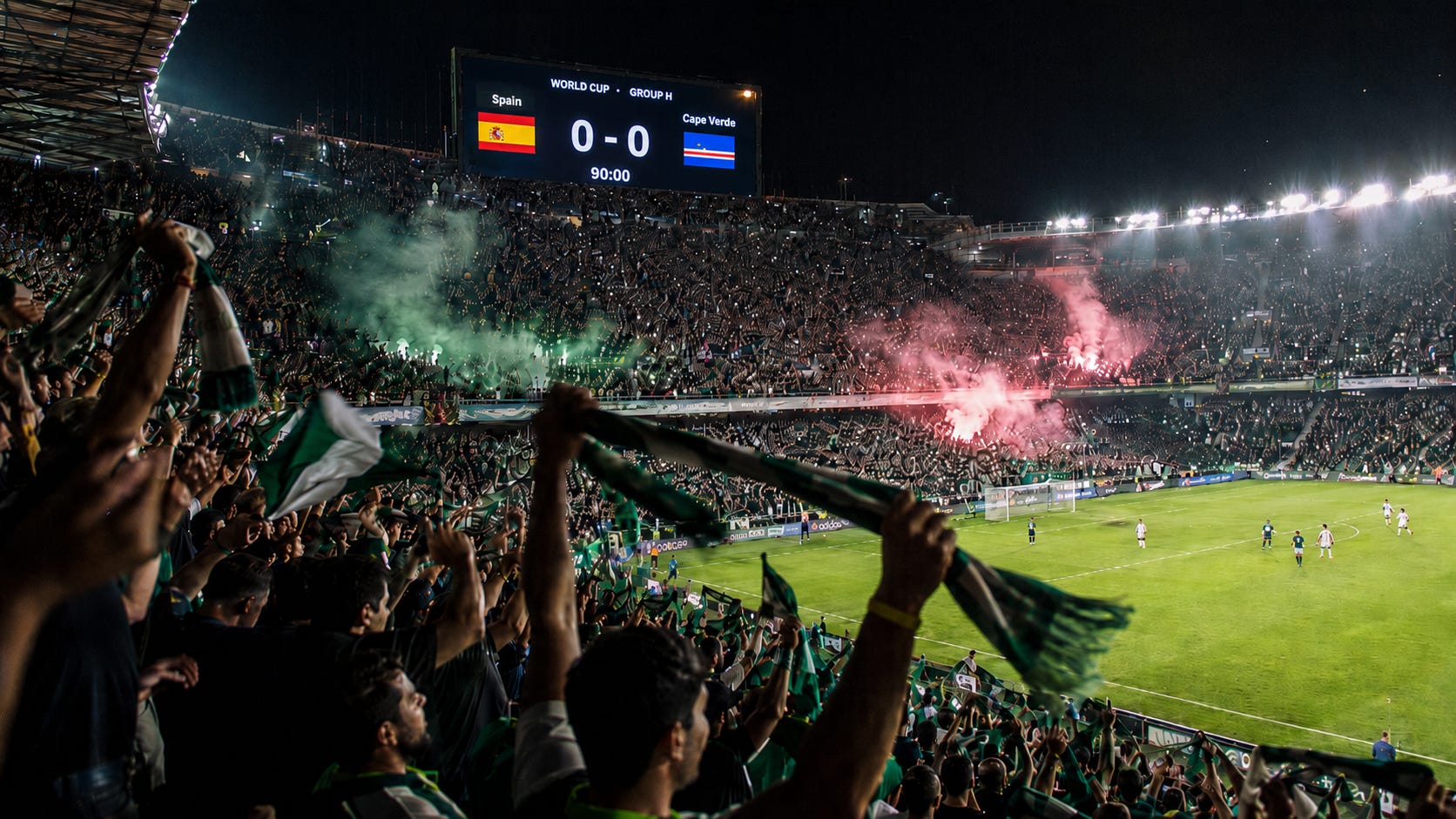
You saw it this month. Spain—European champions, ninety times the population—controlled the ball for 70 percent of the first half and took twenty-seven shots at Cape Verde, who were playing in their first World Cup ever, and could not score once. Cape Verde, a nation the size of Guilford County, North Carolina, then drew all three of their group games and advanced to the knockout round. If this were a one-off, it’d be a great underdog story.
But it happens all the time. In 2018, Iceland, population 350,000, tied Argentina. If tennis worked this way, nobody would ever win more than one Grand Slam, and there’d be a new group of people you’d never heard of in the quarterfinals every time. Which is to say, with soccer, most of what you’re watching is luck. It’s like watching professional roulette on television.
It Bans the One Thing Humans Are Good At
The most basic problem with soccer is even simpler than the fact that it’s mostly luck. The sport’s founding rule is that you can use every part of your body except the one humans are best at. Homo sapiens are tool users. Using our hands is one of the basic traits that separate us from the other apes—we’re extraordinarily good at it, and our entire hunting strategy once depended on it. Our primary evolutionary edge is throwing things. No other animal can hurl a rock or spear with anything like our speed and accuracy. Our legs and feet evolved mainly for running. Soccer takes away the single greatest advantage of an ape that stood up on two legs partly to free its hands. It would be a great sport for a species that hunted by kicking rocks at its prey.
It’s not that dribbling, passing, and shooting with your feet is unimpressive. It’s that it’s impressive the way a dog walking on its hind legs is impressive: the miracle is that it can be done at all, not that this is the highest use of the organism. It would be like a version of basketball where you’re only allowed to dribble with your head. The best players would be some of the best athletes on earth—and they’d be demonstrating nothing except how much human talent can be squandered by arbitrarily banning the one thing we’re good at, provided you force enough children to practice.
Soccer Is All Middle
“Soccer! Fast kicking, low scoring, and ties? You bet!” —The Simpsons
All good sports are stories. They’re built out of discrete units—at-bats, downs, points, possessions—each with a beginning and an end: something is attempted, something is resolved, and then you get another. The historian Michael Oriard, an NFL lineman before he was an academic, put it simply: American sports have a beginning, a middle, and an end. Soccer just drones on—pass it back, pass it sideways, pass it back, pass it sideways, lose it, win it back, pass it back again—for ninety minutes, and almost nothing ever finishes. It’s all middle.
It’s not that nothing happens; it’s that the same thing almost happens, over and over, for two hours. A promising run, broken up. A cross to no one. A shot into the third row. Soccer isn’t really about scoring. It’s about the threat of scoring, endlessly deferred. It’s all foreplay, no sex.
And on the rare occasion that someone does score, there’s a good chance it gets called back because an attacker’s shoulder was eighteen inches too far forward. The offside rule is almost perfectly engineered to erase the only moment worth watching.
The problem isn’t just that scoring is rare. Hockey is low-scoring too. The problem is that effort and reward have almost nothing to do with each other. In basketball, a good pick-and-roll gets you an open shot. In football, a well-executed drive moves the chains. In soccer, twenty beautiful passes end with the ball rolled gently back to the goalkeeper.
But the worst part—the thing that should disqualify soccer as a sport at all—is that a huge share of games end in a tie. Nobody wins. It’s the most anti-competitive outcome in sports—two hours of intense effort that fails to produce a winner—and in soccer it’s not a fluke, it’s routine. More than a quarter of World Cup matches end in a draw, and in some leagues it approaches forty percent. Imagine a movie that just stops at ninety minutes, wherever the plot happens to be— sometimes at the ending, sometimes not — because that’s the rule.
Most matches are decided by a single goal, and many by none at all. One goal is the whole game. And goals almost never come (only about one shot in ten finds the net), and the team that scores first wins two-thirds of the time. Put these statistics together and the incentives are perverse. Giving up a goal is catastrophic, and the chance of scoring isn’t worth the risk of getting caught upfield when the other team counterattacks. So from the opening whistle the smart play isn’t to attack—it’s to play not to lose. Hold your shape, keep everyone back, pass it sideways, and wait for a mistake. Every other sport rewards you for trying to score. It’s boring by design.
Methinks the Beautiful Game Doth Protest Too Much
The more a sport has to be intellectualized, the more boring it is to watch. And with the exception of baseball—the world’s second most boring sport—no sport is intellectualized like soccer. Tell a soccer fan how bored you are at 0-0 with five minutes left and you’ll be told you don’t understand the buildup, the spacing, the shape, the press, the movement off the ball. Sometimes that’s real—sometimes the spacing is genuinely impressive. But most of the time it means nothing happened and you’re being asked to admire it anyway. It’s a status move: the less obvious the entertainment, the more refined you get to feel for claiming to see it. It’s wine culture applied to sports: the fewer the pleasures available to the ordinary senses, the more elaborate the vocabulary required to appreciate them.
A soccer fan will almost certainly tell you it’s the scarcity of goals that makes each one so precious. The endurance, the geometry, the flow. The global passion is unmatched. It’s all a rationalization for the fact that nothing happened. And if you still don’t see it, that’s not the game’s fault—it’s yours, because you’re an unrefined American buffoon.
Notice that the elite magazines never write about the actual games. Every World Cup, the Times and the Atlantic and the rest fill up with gorgeous, soaring essays about the tournament—and almost none of them are about the tournament. They’re about the Senegalese and Scottish fans singing together, the Texas town that adopted the Algerian team, the multicultural miracle, the world united for a month. It’s often moving but it’s always a tell. Nobody bloviates for two thousand words about the hidden genius of a zero-zero tie. When a sport is genuinely thrilling, the writing is about the sport. When it isn’t, the writing gets very spiritual fast—suddenly it’s about mortality and belonging and the human capacity for grace, the prose swelling to fill the silence where the excitement was supposed to be. When the most moving thing about your sport is the friendliness of the parking lot, the crowd isn’t the story. It’s an alibi.
Baseball does the same thing. It’s another slow, boring sport that someone will explain is really a meditation on democracy, on America, on fathers and sons, or the passage of time. It’s like an NPR host walking into a bowling alley and discovering the real America.
And most of the time you can’t even tell who’s good. Turn the sound off and my mother could pick Michael Jordan out in a minute—he’s the guy taking over the game in the final minutes. Put her in front of a soccer match and she’d have no idea that Lionel Messi was even on the field. No one ever has to explain why a buzzer-beater, or a receiver dragging one foot in bounds in the corner of the end zone under double coverage, is exciting. It’s obvious.
***
I get that arguing that soccer is boring is both obvious and a little tedious. But watching soccer sucks, and everyone has quietly agreed to pretend it doesn’t. None of this is a criticism of the players. Soccer players are probably some of the best athletes on the planet. FIFA counts 265 million players worldwide, and only about 0.04 percent of them—one in 2,300—ever sign a professional contract of any kind. The fraction who reach the top five European leagues is around 0.001 percent. One in a hundred thousand. No height requirement, no equipment—just any kid who can afford a ball, and the planet sorts them down to a few hundred. Compare this to basketball, where height is such an enormous filter that one widely cited estimate put the odds of a seven-foot American man playing in the NBA at 17 percent.
But that’s why it’s so tragic. Soccer takes the largest, most brutally filtered athletic talent pool on earth—and wastes it by paying players millions of dollars to prance around in circles for ninety minutes and try to score once with their feet. Soccer was never designed to be watched. It just grew—cheap, simple, fun to play, and carried around the globe by an empire that owned a quarter of it. By the time anyone thought to ask whether it was fun to watch, it was already everywhere.
Soccer’s rules were written down in England in 1863, before any of the good sports existed. By the time someone built a game where you could use your hands, where scoring was common and luck was rare, soccer already had a half-century head start and most of the world’s children. It isn’t popular because it’s the best. It’s popular because it got there first.
I could recite all the tedious, oft-repeated ways to make soccer less boring—widen the goals, shrink the field, add hockey-style power plays, lose the goalkeepers, and give one player per side (the Reaper) a metal pole he may use to strike an opponent in the face no more than five times per game, provided he isn’t offside. But I don’t have time to solve all of soccer’s problems.
Soccer’s greatest trick is convincing a billion people that frustration is suspense, that scarcity is beauty, and that being bored stiff means you’ve finally become sophisticated.
Another boring British sport that spread long before the good ones were invented
I don’t believe I’ve ever read a indictment of soccer with which I agree so completely.